Named One of the Best Educational Blogs 2010 by the Washington Post

9 Articles Categorized in "Weblogs"

Amethyst Hinton Sainz | Education, Education Policy, Professional Development, Teacher Leadership, Weblogs | May 20, 2013

You Must Write Your Teacher Life

1

Student-writerI am not a natural storyteller. Often, when I tell my husband about something that has happened at school, he will nod expectantly and say, slightly impatiently, “And...?” to hurry me to the point because he knows it might take a while. I’m tangential.

And that is one reason I believe that writing is a good thing in my life. It allows me to rant, cry, pout, veer off into vectors, and spiral back to what is essential. Revision (i.e. chopping down ideas and putting them in an order that makes sense to someone) is a good thing. In my (wonderful) graduate program, I took a class called “Rewriting a Life” by the wise and lovely Tilly Warnock. The premise of the class was that the act of writing out our lives reshapes them, and makes meaning from our memories. One of our texts was You Must Revise Your Life by poet William Stafford, from which I stole the title of this entry. It helps my stories make more sense to my husband if I go through a bit of a selective process before I tell them.

I remember in my teacher ed classes way back in the early ‘90’s, we were advised to keep a reflective journal. It was a great suggestion. But it is quite a commitment to say you will write each day about your teaching. Hats off to those who manage it. I mean, really. Hats off. It is a courageous act, much like videotaping oneself, to keep a teaching diary. I think if I did that I would never re-read it. It’s too terrible to see who we were yesterday. But, for me, it is incredibly helpful to take stock of who I am today.

I have greatly enjoyed keeping both a personal blog (which often veers toward professional issues) and also contributing here. I think it is good policy for teachers to be writers, and here’s why:

A. Personal and professional development. Much like practicing any art form, writing will shape you and your identity.

B. Learning real writing processes. Writing helps us relate to the writing processes our students go through and become better teachers of writing (which most of us, ultimately, are at some point). (For more thoughts on this, see a speech I delivered about the National Board writing process.)

C. Entering the conversation. If you blog your reflections, and read other ed blogs, you will soon find other voices who enrich your professional life. Also, having readers is nice.

D. Creating a diverse chorus of teacher voices which will at some point take out the Death Star (however you define the Death Star). Many policy makers still have a dim idea of what life in the classroom is like. Ideologies drive much of the public conversation. Ideas can be argued, but it is hard to argue with your experiences. The stories of teachers and students are the reality of education today.

Take some time this summer to jot your thoughts. Join the conversation. Have a great summer!


Amethyst Hinton Sainz | Education, Education Policy, Life in the Classroom, Literacy, Professional Development, Teacher Leadership, Web/Tech, Weblogs | March 22, 2013

What If? (#3) OR Why My Teacher Website is So Ugly

0

What if school systems were responsive enough to keep up with the pace of technology?

When it comes to my ability to integrate an online learning experience for my students into my courses, I don’t think my saga of frustrations and dead-ends is unique.  I have some good ideas (toward the end), but please indulge me in a bit of the saga first.

I have many goals for my teacher website(s):

  • Ongoing communication with students and families.
  • Making class handouts and notes available online.
  • Building a learning community among my students:  online discussions, responses to each others’ work, using each others’ work as models, helping students to create digital products (podcasts, videos, blogs, etc.)
  • Developing a sense of audience for students; showcasing their finished work for each other or publicly.
  • Curating a resource for assessment and reflection. A whole collection of student work is  easily available for me to peruse.       

As you can see, at least for me, it is not enough to simply have my name and contact information posted on a school site. Nor is it enough to have a static, Web 1.0 web presence with my students.  We need a site that is responsive, collaborative, and interactive, and that allows students to consume, create and reflect on digital media.

Some districts may provide a platform for this kind of online classroom in every class; mine doesn’t.  We have technology, but it is not nimble enough to meet the demands I’ve listed above, goals which are perfectly reasonable and authentic given the digital environments in which many of our students work and play by choice, and given the world of academic and professional work they will be entering.  

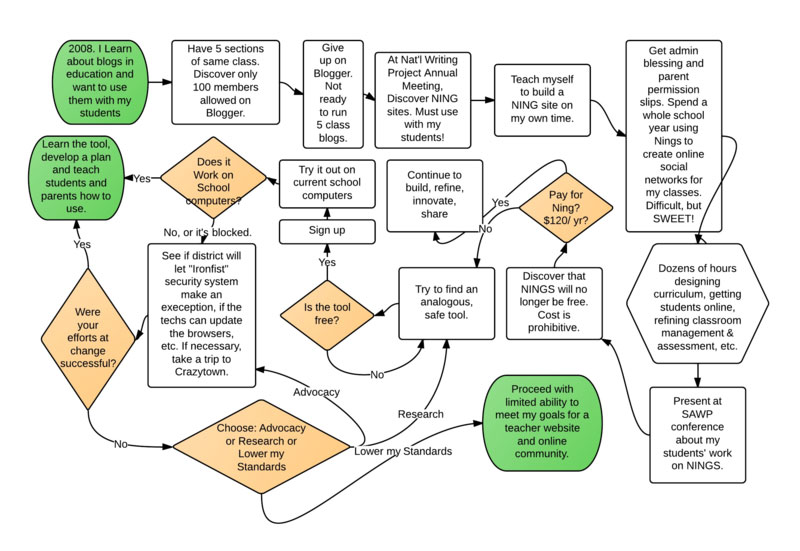
I need to tell my story here, but I’m desperately afraid it will be long, rambling, full of frustrations you won’t want to re-live along with me.  Perhaps I can tell that story with a flowchart.  


Flowchart wiki
Click here to view a flowchart of my experience developing an online learning environment.  I actually left out several steps.

Or click this link. 

Of course, now that I have learned Wikispaces and fully integrated it into my class, I am learning about others on campus who use Edmodo and other sites that have a much prettier interface, integrate Google Drive better, etc.  Unfortunately, I’ve already invested so much time in my clunky little wiki world that it’s too late.  I simply can’t shift my classroom community partway through the year.

So, finally, my proposal, my “What If?”

What if districts innovated ways to be responsive to teachers’ needs to use up-to-date web tools as part of their classroom communities?  We are not in a world in which districts can afford to have technology plans take multiple years to be implemented; teachers need the ability to use new tools judiciously as they see fit.  By the time those plans are implemented and teachers are trained, the tech has evolved beyond the original conception.

Here are some components of what I think such a nimble technology plan might include:

  • Mini-grants to teachers of $200-$1000 for web-based technology needs.  Short form grant applications similar to the proces for applying for a field trip. Teachers could use these grants as needed to subscribe to podcasting sites or other web tools useful for their instructional goals.
  • Tech support that includes teacher-leaders whose job is to assist classroom teachers in discovering, learning and implementing new technology tools to meet learning goals for students.
  • Limited administrator access to our own laptops to load software such as printer drivers, updates to browsers, e-book software from the public library, etc.
  • Ongoing training for teachers to make them aware of issues of privacy, security, ownership of digital products, copyright issues and other issues inherent in having students work online.
  • Flexibility in blocking and unblocking sites for various levels of students or even specific groups of students for particular purposes.
  • Development of student leadership and mentorship for tech tools.


Up-to-date hardware and software is only part of the issue, a sort of a minimal entry-level requirement for working with students in digital environments.  Teachers in classrooms have a unique vision of what we and our students need to create the digital environments that will efficiently enhance the learning in the classroom.  Empower us to make key decisions regarding how new online tools can help our students.  Students will learn these things quickly; except for those with very little exposure, they already do.  It is often schools and districts that slow them down.


Amethyst Hinton Sainz | Education, Education Policy, Professional Development, Web/Tech, Weblogs | September 20, 2012

Out of My Mind?

0

Humor me by drifting down a little stream-of-consciousness here.  Tonight I realized I had missed my assigned day to post to this blog.  I looked at the assigned date, and laughed.  It was a day I had allowed myself to somehow believe I could simultaneously be at the AZK12 Ken Robinson book club (for the book Out of Our Minds: Learning to be Creative) and be at parent teacher conferences at school.  Had I somehow managed to get all three of my obligations onto my calendar, maybe I would have planned better.  But Sunday was spent on some freelance work that helps to supplement my teaching salary.  Saturday was chores.  Last week was a blur of grading frenzy after travel to a family wedding and in anticipation of parent conferences.  163 students is more than I’ve ever had in 17 years, and coming to terms with the obvious and subtle ways that shapes my teaching life is the subject of a whole other blog entry, but…

I am also highly distractable by nature (and maybe by caffeine).  Last year in the high school creative writing class I teach, I had several intensely creative students who inspired me to re-embrace reading and writing in my own personal life.  I rediscovered how much fun it was to just read and write… for fun, and to think and communicate.  Much of it I revised, sometimes intensively, and shared.  At any rate, I write almost daily now, for fun, and have a personal blog, which I was updating with wedding photos just about the time I realized I had better check my schedule here.

Being the distracted momteacher I am, during my freelancing work writing content for AP Language and Composition textbooks on Sunday, I began the following exchange on Facebook:

Creative disc
My Status:

 I want to be Annie Dillard.

"It is possible, in deep space, to sail on solar wind. Light, be it particle or wave, has force: you rig a giant sail and go. The secret of seeing is to sail on solar wind. Hone and spread your spirit till you yourself are a sail, whetted, translucent, broadside to the merest puff."

"I had been my whole life a bell, and never knew it until at that moment I was lifted and struck."
Annie Dillard

Comments:

Brilliant English Teacher Friend: Pilgrim at Tinker Creek is my favorite book ever. :)

September 16 at 8:37pm via mobile · Like

Amethyst Hinton Sainz I knew i liked you for some reason... :) P.S. tomorrow night is P/T conferences! Didn't realize the book club conflict until just now! Wah.

Monday at 6:10am · Like

Amethyst Hinton Sainz I keep coming back to Annie Dillard as a model for all I admire in good writing. She is the real ####. When I read her again after a long absence it's like coming home. Wish I could have her spiritual clarity!

Monday at 6:11am · Like

Brilliant English Teacher Friend: I sometimes dream of my own Tinker Creek or Waldon Pond. What must it be like to have nothing else to do but observe the world and write? *sigh*

I've been working -- quite literally -- all weekend. (Ok, I took time for dinner and a few episodes of "Arrested Development" with Peter last night.) Didn't even get time to crack open the Robinson book. I'm booked through this evening, too. I can't even keep up with a dang book club. When am I supposed to write?? :(

Monday at 6:14am · Like

Amethyst Hinton Sainz I can't keep up, either. What was I thinking joining a book club? What you do is you write with your students.


I somehow did manage to write with my students much of the time last year.  Somehow we all created a space for it, and it was a joy.  However, right now I’m writing for maybe 10 out of their total 45 writing minutes per week.  I need the time to finish prepping, getting work back to them… it’s tricky.  And the engagement strategy of open writer’s notebook time for 15 minutes a day doesn’t fit into the Common Core so well on its own merits.  But I feel justified because creative writing is an elective, and the kids need that space.

In our first, earlier, book group meeting about the creativity book, the conversation veered dangerously close to a stereotypical teacher lounge whine, and I know we all felt it.  It’s hard to vent our many frustrations without going there… it is a challenge to be continually solutions-oriented.  But in order to find solutions, problems must be thoughtfully identified.  Most of us there felt that in the schools where we worked, innovation was actually discouraged either by curriculum maps and pacing calendars, evaluation systems (especially the new emphasis on student achievement data), and largely by lack of time to jump off of the multitasking treadmill of our day and to think, dream, wander… and to be wrong.  In his well-known TED talk, Ken Robinson says “If you’re not prepared to be wrong, you’ll never discover anything original.”  I would add “If you’re swamped with attendance, e-mails, planning, grading, testing, and meeting individual student needs….”

I don’t have a lovely metaphor to pull this one together.  All I know is that before I started writing this, I set out on Google to see if I could find the source of that oft-used-in-powerpoints graph that shows the yearly cycle of teacher morale.  That yearly cycle hits a low, if I remember correctly, around October 18, excatly a month off from* the day which I now realize I was supposed to be at a professional book group on creativity, be meeting with parents, and posting a blog entry about how policy meets practice.  This after a weekend of nine hours writing multiple choice questions for extra pay, and earning much more per hour producing educational materials than I earn after 17 years of teaching those materials. 

I did not find the research I sought, but I found a slew of articles from last spring saying that teacher morale was at an all time low.  Perhaps I can wrangle this wayward reflection back to the idea that one contributing factor to low teacher morale is that so many of us are frustrated on a creative level.  We need time to sharpen the saw, read a book, write poetry, observe our own Waldens, and figure out what we really think.  Many of us are killing ourselves reaching for that. And the fact that I ignored my own children’s bickering and bedtime resistance to write this only adds the last touch of evidence to my meandering argument tonight.

*We started school earlier, so I'm chalking my early visit to low-morale land up to that.  

Cheryl Redfield | Current Affairs, Education, Education Policy, Games, Life in the Classroom, Mentoring, National Board Certification, Parent Involvment, Professional Development, Sports, Teacher Leadership, Weblogs | February 13, 2012

An Unlikely Dream

6


Jeremy LinMany times as educators---just by the nature of our profession-- we’re in it because we love kids and are driven to leave a legacy of learning for the next generation. 

The very nature of the people who are called to this profession is that often we wear our hearts on our sleeves; and in such a precarious position, our hearts are easily bruised.  And over the years, some of the energy, some of the vibrancy, some of the optimism, some of the hopeful expectation is diminished because we feel marginalized, devalued, and stereotyped.

 As a National Board Certified teacher, I must confess that recently I was going through such a funk; and I know better.  But I received inspiration from a very unlikely source.  He and I don’t know each other, we’re not in the same profession, we don’t collaborate via webinars, neither is he one of my FB friends. But his story spoke to my heart in a way that I gained fresh perspective about a difficult two week period in my life. 

In the midst of my pity party came Jeremy Lin.  Just in case you don’t know who he is, permit me a moment to share the little that I know.

Jeremy is a basketball player of Asian descent who, after graduating from Harvard, became an undrafted talent looking for a place in the NBA. Two years and three teams later, up until a week ago, he'd seen about as much playing time as I have.  As circumstances would have it, a series of injuries on the team catapulted him into the unlikely role as the starting point guard for the floundering New York Knicks. In one week, his record-setting accomplishments have inspired people all over the world to not give up on their unlikely dreams!

 So here I am, on the other side of my funk, glad to say that my unlikely dream for the teaching profession is still intact.  “I still believe that in spite of everything” that, strengthened by the National Board Standards, the teaching profession can:

  • be one that is highly respected and well-paid
  • create a self-regulating licensing board, much like the legal and medical professions, that retains and rewards the effective teachers and, for evidence of malpractice, weeds out the ineffective
  • develop and implement rigorous university-based teacher training programs that adequately prepare future teachers for tomorrow’s classrooms
  • lead the way in transforming how schools are funded in this country
  • be transformed from a job of last resort to (as coined by my friend Alaina Adams) a League of Extraordinary Educators.

To the regret of the teams who let him go, Jeremy Lin has not only led the Knicks on a five-game winning streak--an experience they’ve not enjoyed for awhile--but he’s set some amazing records along the way in his first four games as a starter. 

In all this I can’t help but wonder how many schools, how many districts, how many departments of education have devalued their "Jeremy Lins" and now sit in the stands watching those extraordinary educators invest their talents into transforming other systems into winning teams?

 Let’s learn a lesson, that’s come unfortunately too late for Jeremy’s former teams: we need to do all we can to retain, empower and reward accomplished teachers. Period. 

 But if you find yourself feeling like an undrafted, unwanted talent whose value and efforts are marginalized, take heart; be inspired by Jeremy Lin’s story.

 You too can make your unlikely dream a reality.


Cheryl Redfield | Current Affairs, Education, Life in the Classroom, Mentoring, Professional Development, Religion, Social Issues, Teacher Leadership, Weblogs | January 14, 2012

I Have a Dream

4

MLKaspxOn the eve of the commemoration of Dr. Marin Luther King, Jr. let me echo the title of his famous oration by saying, I have a dream, too!

 During the era of his speech the equality of all Americans, as our forefathers envisioned, was far from reality.  Our nation couldn’t have been more polarized by race. 

 On August 28, 1963, from the steps of the Lincoln Memorial, Dr. King shared his dream with millions of people- the masses before him as well as those glued to their radios and television sets across the country. 

 I remember that day-- very well-- and the barely muted excitement of my home as we prepared for the evening’s rebroadcast of Dr. King’s speech, given earlier that day. As a child I don’t recall a greater sense of anticipation, except for Christmas time.

 You see, my parents had a dream for me—when I hadn’t as yet developed a dream for myself.  And Dr. King’s speech seemed to validated their right to embrace lofty goals for their three children. Eventually though, as I grew older and understood the nature of the man-made obstacles born out or racial and gender barriers, I determined to make my parents’ dream, my dream too.

 My parents’ dream for me and my younger sister and brother included good character, a college education, and love for all people- regardless of race or creed.  But the impact of their dream for me was the careful preparation and footsteps they provided for my brother, sister and me to walk in. They carved out a path and modeled for us kids what it looked like to value wisdom, all people, and education, the details of which there’s not time nor space here to elaborate. Suffice it to say, we’ve done our best to follow our parents’ example.

 But it all began with a dream.

A dream shared, a dream believed, a dream lived.

 In living my dream, I have a dream for others, beyond my own family.

 I have a dream for my students- for all students in America...


I believe in their innovation and creativity.

I believe in their ability to think critically.

I believe that if they conceive it, they can achieve it.

I have a dream.


I believe in their desire to make a difference.

I believe in their ability to communicate clearly and globally.

I believe that if empowered, they will change the world.

I have a dream.


I believe in their capacity to love and understand.

I believe in their ability to judge the heart and character of a person.

I believe that if encouraged they will express compassion beyond their years.

I have a dream.


I have a dream.


Alaina Adams | Current Affairs, Education, Education Policy, Elementary, Life in the Classroom, Mentoring, Music, National Board Certification, Parent Involvment, Professional Development, Social Issues, Teacher Leadership, Web/Tech, Weblogs | October 17, 2011

Protecting the Teacher AllSpark

0

TransformerI read Bill Ferriter's blog this week about the story of Mitchell 20, a movie about 20 Phoenix elementary teachers who chose to pursue National Board certification as a way to take control of the one thing they could control: the quality of their instruction. In his blog, Ferriter summarizes the movie as a collective recognition that "waiting for Superman is a strategy that is failing our students." Instead of this one-superheroed-approach, Ferriter proposes that "super powers really do rest somewhere deep within each teacher."

Kudos Bill: this Arizona edu-blogger agrees on all counts. I attended the Phoenix premier of the movie last week and, though our Superintendent of Public Instruction erroneously referred to the group of teachers as "The Wilson 20," there were plenty of positive references to the internal motivation and "spark" that keeps super-hero teachers in our classrooms - in spite of out of touch politicians and/or public vilification of the profession.

Daniela Robles, the heroine in the film, said something during the panel discussion after the movie that really struck me. She said, "It takes one person to cause a spark that sets a fire."

Since superheroes are thematically connected to education these days, I immediately thought of the AllSpark in the Transformers movies (insert 4-count break and theme song music here). Though Megatron-like current educational trends want teachers to be "robots in disguise," teachers really are more than meets the eye - and the story of the Mitchell 20 demonstrates that. First generation Transformers fans know that the AllSpark is best defined as, "that indefinable, indescribable energy that makes them truly alive, more than mere machines."

But what *is* that AllSpark for teachers and how can we help protect them from the Educational Megatrons and Decepticons of today and tomorrow? Maybe we should be education Transformers instead of "reformers?"


Julie Torres | Current Affairs, Education, Education Policy, Life in the Classroom, Social Issues, Web/Tech, Weblogs | September 30, 2011

Access Denied

5

Blocked Sites Image Last week I received an email that made me chuckle.  Apparently, Banned Website Awareness Day is spreading across the web.  Educators nationwide are arriving at work everyday to find that they can no longer access websites that support their classroom instruction and communication with students and families.

Blocked sites vary from school district to district, among the blocked sites are Wikispaces, Ning, Glogster, CNN, History Channel, National Geographic, Google Docs, Dropbox, Teacher Tube, YouTube, Twitter, Facebook and various blog sites.  The policy of filtering these sites inhibits teachers from fully meeting the needs of Digital Natives and 21st Century learning.

Students in classrooms today have never experienced life without the Internet, it is their primary source for communication, information and exploration; except at school.  Schools are often zones of Internet isolation with students having limited time and exposure to digital technologies.  It is the equivalent of living in two countries, crossing the border each day and having to speak two languages.  The students in America’s classrooms speak “Digital”.  Teachers are too often speaking “Pre Digital” and the two conflicting ideologies about digital technologies, cause students to tune out.   This clash of cultures leaves many students disconnected, frustrated and uninterested in school.  

Teachers maximizing the use of technology are also frustrated by these policies, they may spend hours uploading plans, resources and images to a site for classroom use only to discover without warning that they can no longer access that material from their classrooms.  While some school districts have procedures for unblocking sites, busy teachers seldom have time to tackle the layers that are required to gain access to sites, some teachers have reported needing to write lengthy rationales that include lesson plans with timeframes just to have sites unblocked for a couple of days. Teachers frequently give up and revert to using less effective methods of teaching. 

Learning how to use websites responsibly and effectively must become a priority; policies need to be adjusted to support teachers as they model and teach students appropriate uses for digital technologies.

The irony in all of this is that students know how to bypass most blocked sites and the teachers end up being “blocked” from using better means to teach.


Delyssa Begay | Education Policy, Web/Tech, Weblogs | January 11, 2011

Technology...

3

It's winter, and luckily, the internet has been working without major glitches (knock on wood). Sometimes, major storms - wind, rain, snow - can knock off the internet connection for hours. On the reservation,  it's the schools, businesses, and hospitals that feel it most when there is a telephone and internet problem. It's slowly changing though, a few more families have internet connection and a home computer; and most often schools receive laptops from major donors.  The challenge is when the bandwidth band or connection doesn't match up to the newest laptops, or so many websites are blocked that using the internet is more work than expected. 

Meeting technology demands can be challenging for rural schools - on or off Indian reservations. I am reminded of Mike's article about his school's new laptops making the news, and generating criticism because of the tight budgets in most schools. Many schools on the reservation have begun to invest in electronic equipment with mixed results too. Maintaining the equipment and upgrading for the internet connection speed often lead to frustration. Many schools are trying to find the balance electronical devices have in students' lives and the distractation they cause.

There was a moment of silence for the terrible shooting in Tucson, and sadly, many of the students were not aware of the incident because they did not have television or internet news to inform them. 

Annie Diaz | Education, Mentoring, National Board Certification, Weblogs | November 21, 2010

Why I teach?

3

by Annie

This past week was American Education Week and it was suggested to post a” Why I teach?”  Blog. I pondered this notion for the entire week…I realize, as an educator that people probably think most teachers should easily be able to spew a monologue about all the reasons why they teach. I love being a teacher, don’t get me wrong, but I admit that I gave this  a lot of thought…it took me awhile to come up with this one.  I want to be honest, relevant, and real. These examples are based on my personal experiences as an educator within this past month. So here it goes… Why I teach?

  1. To mentor and care for the students who come to school because “its their happy place.”
  2. To support the teachers who want to become better for their students and pursue the most rigorous professional development, National Board Certification, on their first, their second, and sometimes third attempt...So inspiring..Wow!
  3. To learn from the inspirational experiences while also growing from professional humility, witnessing friends rise to prestigious recognition such as Teacher of the Year while learning and reflecting from my personal experiences, such as being rejected as Teacher or the Year. yet I‘m still here and still growing as an educator.
  4. To serve as a leader and collaborator in my own community of practice, my school, my network of educators, and my own personal community.
  5. To work hard, teach hard, and enjoy the moments that no other profession gives… I get to experience the smiles, the laughter and the “oh now I get it Ms. Diaz!” moments! 

This is why I teach.